To create an effective NCLEX-RN® study guide, focus on key concepts from major nursing domains. Consider creating a cram sheet as part of the guide to reinforce need-to-know concepts. Incorporate a prep program like Slone NCLEX into your study plan for a well-rounded approach. As you prepare for the NCLEX-RN® exam, it’s a great idea to create...
The Next Generation NCLEX (NGN NCLEX®) has brought changes to the exam experience that could require you to change your study approach. The design now mirrors real-world nursing practice and includes helpful features like partial credit for certain question types. Consider the sample scenario as explained by Slone NCLEX Professor Tanya Killian. The Next Generation...
The right strategies and a positive mindset can give you the extra boost you’ve been looking for as you prepare NCLEX® study guides and get ready for exam day.
Prep programs like Slone NCLEX provide a nice supplement to your study materials.
Slone NCLEX Professor Tanya Killian breaks down even more NCLEX® study dos and don’ts to help you focus.
Preparing for the NCLEX® can be a bit daunting, but with the right strategies and a positive mindset, you can tackle it with confidence! Here are some NCLEX® study tips to help you along the way.
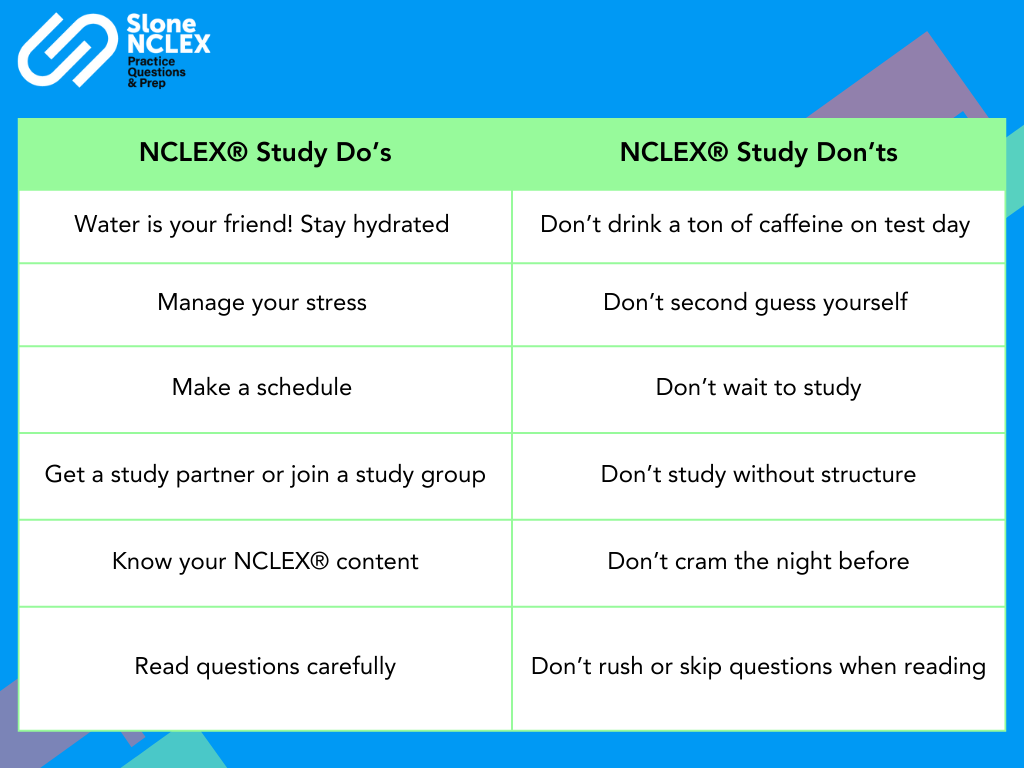
First, we will give you a quick reference guide and then a little more detail below for your NCLEX® Study Dos and Don’ts.
Let’s focus on the NCLEX® Study Do’s!
Develop a study plan: This is key! Make sure that you make (and follow) a study plan. This will help you to stay on track and stay focused. It is easy to lose the rigor and routine of nursing school once you have graduated, but remember you ... Read more
To create an effective NCLEX-RN® study guide, focus on key concepts from major nursing domains.
Consider creating a cram sheet as part of the guide to reinforce need-to-know concepts.
Incorporate a prep program like Slone NCLEX into your study plan for a well-rounded approach.
As you prepare for the NCLEX-RN® exam, it’s a great idea to create a study guide that covers key concepts from the major nursing domains. Here are some friendly suggestions to make your study process effective and enjoyable!
Key Areas to Include in Your NCLEX-RN® Study Guide
Safety and Infection Control: It's important to think about keeping everyone safe and healthy. This means understanding infection control, safety procedures, and being aware of potential hazards. Remember to always select the options that practice good hand hygiene, wear personal protective equipment (PPE) when needed, use sterile techniques, and keep an eye out for anything that could be a safety issue in healthcare settings.
Management of Care: Prioritize tasks and delegate responsibilities effectively. It's all about teamwork! Making sure everyone has their roles, advocating for our clients, and managing resources well helps us provide the best care. This area really tests how well you can oversee the overall care delivery process for your clients.
Health Promotion and Maintenance: This includes discussing health screenings, preventative care, lifestyle changes, and finding effective ways to educate patients. The goal is to support our clients in maintaining their health, preventing illnesses, and catching any early health concerns at different life stages.
Psychosocial Integrity: Supporting your clients’ mental and emotional well-being is crucial. The NCLEX will test you on your ability to do so. Ensure that your NCLEX-RN® study guide includes mental health disorders, interventions to help clients cope with grief and loss, exploring healthy coping mechanisms, and enhancing communication skills to better connect with them.
Basic Care and Comfort: Ensure that you can identify options that provide essential care and assistance with daily activities like hygiene, positioning, mobility, nutrition, and hydration to promote overall well-being.
Pharmacological and Parenteral Therapies: Get comfortable with medication administration, understanding drug interactions, and the principles behind IV therapy, all while ensuring that you are providing safe and effective care for your clients.
Reduction of Risk Potential: Identify and prevent any areas that might complicate a client's condition. This means recognizing abnormal vital signs, interpreting lab results, and taking precautions to minimize risks related to treatments or procedures.
Physiological Adaptation: Understanding fluid and electrolyte balance, managing medical emergencies, and comprehending disease pathophysiology to help recognize cues and intervene. It's all about being ready to respond to your clients' needs!
Important Concepts For Your NCLEX-RN® Study Guide:
Assessment: Conduct thorough head-to-toe assessments, keep an eye on vital signs, and improve your data interpretation skills.
Clinical Reasoning: Apply your nursing knowledge to real client situations and enhance your decision-making abilities.
Therapeutic Communication: Practice active listening, show empathy, and learn to provide clear, helpful information.
Critical Thinking: Strengthen your ability to analyze situations, spot priorities, and solve problems effectively.
Practice Questions: Mix it up with different question formats — try multiple-choice, select all that apply, and drag and drop!
Pay attention to the rationales for both the correct and incorrect answers: This will really enhance your understanding. Don’t forget to review practice questions from various sources (including Slone NCLEX) for a well-rounded prep experience!
[sp_wpcarousel id="1062"]
Final NCLEX-RN® Study Guide Tips
Prioritize Based on the NCLEX Blueprint: Spend a little more time on the areas that are weighted more heavily on the exam.
Use Mnemonic Devices: Get creative and come up with memorable tricks to help you remember key concepts. Slone NCLEX has great mnemonics you can use. Our TikTok/Instagram goes over these to help you as well.
Active Recall: Challenge yourself with flashcards or question banks. It’s a great way to test your knowledge!
Regular Review Sessions: Make it a habit to revisit what you’ve studied to keep everything fresh in your mind.
The Bottom Line
Remember, this NCLEX-RN®study guide should reflect your personal learning style. Take the time to identify your strengths and weaknesses so you can focus your efforts where you need them most. You’ve got this! Happy studying!
[post_title] => Creating the Definitive NCLEX-RN® Study Guide
[post_excerpt] =>
[post_status] => publish
[comment_status] => open
[ping_status] => open
[post_password] =>
[post_name] => creating-the-definitive-nclex-rn-study-guide
[to_ping] =>
[pinged] =>
[post_modified] => 2025-01-20 16:37:28
[post_modified_gmt] => 2025-01-20 16:37:28
[post_content_filtered] =>
[post_parent] => 0
[guid] => https://nclex-review.com/?p=1004
[menu_order] => 0
[post_type] => post
[post_mime_type] =>
[comment_count] => 0
[filter] => raw
)
[1] => WP_Post Object
(
[ID] => 995
[post_author] => 3
[post_date] => 2025-03-05 06:45:31
[post_date_gmt] => 2025-03-05 06:45:31
[post_content] =>
The Next Generation NCLEX (NGN NCLEX®) has brought changes to the exam experience that could require you to change your study approach.
The design now mirrors real-world nursing practice and includes helpful features like partial credit for certain question types.
Consider the sample scenario as explained by Slone NCLEX Professor Tanya Killian.
The Next Generation NCLEX (NGN NCLEX®) has brought some exciting changes to the exam experience, showing much higher pass rates than the traditional NCLEX. In 2023, the year the NGN made its debut, the pass rates were 88.56% for the NCLEX-RN® and 92.10% so far for 2024. That’s a big improvement! Just to compare, before the NGN NCLEX® rolled out in 2022, the pass rate for NCLEX-RN® was 79.9%.This increase is largely attributed to the NGN design, which mirrors real-world nursing practice and includes helpful features like partial credit for certain question types. The NGN NCLEX® employs an improved format for its questions, focusing on a more scenario-based approach that frequently incorporates case studies. This method is believed to better evaluate candidates' clinical judgment and decision-making skills. To successfully pass the NGN NCLEX®, you must have a comprehensive understanding of the exam structure and its content.
Here are a few key NGN NCLEX® areas you should focus on:
Know the Exam Format: Understand NGN NCLEX® structure, including the types of questions, both the traditional types (such as multiple-choice questions) and the new item types (such as case studies and drop-down questions) and how they evaluate clinical judgment.
Create a Study Plan: Develop a structured study schedule covering all essential nursing concepts, prioritizing areas needing more practice. Use memory aids like mnemonics to retain important information and nursing principles. Identify the areas where you struggle and focus your study efforts on those topics.
Practice with NGN Questions: Use practice exams and question banks specifically created for the Next Generation NCLEX® to become familiar with the question style and format.
Join Study Groups: Collaborate with peers to discuss complex topics and gain different perspectives on nursing concepts.
Apply Clinical Knowledge: Remember to leverage your real-world nursing experience and clinical judgment when answering questions. Always, keeping in mind that the NCLEX® will test you on perfect-world nursing, having all resources available.
Understand the Clinical Judgment Measurement Model (NCJMM): Familiarize yourself with this model, as it is the foundation of the NGN, outlining the decision-making process. Remember the clinical judgment categories: Recognize cues, analyze cues, prioritize hypotheses, generate solutions, take actions, and evaluate outcomes.
Manage Test Anxiety: Practice relaxation techniques and employ time management strategies to stay calm during the exam.
If you're wondering about the best way to approach the NGN NCLEX®, the answer is with peace of mind knowing that the NGN NCLEX® is for your benefit.To further help you understand the NGN NCLEX®, let’s complete this case study together.
Scenario: The client presents to the emergency room with new-onset, right-sided facial drooping and weakness. They are alert and oriented to person, place, and time but are unable to explain why they are in the hospital. The client follows commands appropriately but shows distinct weakness on the right side. When asked to smile, facial drooping is noted on the right side. Drooling from the right side of their mouth. The client is able to maintain eye contact and no visual loss is noted. Their National Institutes of Health Stroke Scale (NIHSS) score is 8. Lung sounds are clear throughout, and peripheral pulses are +1 in all extremities, with pitting edema noted in the bilateral lower extremities. S1 and S2 heart sounds noted. The abdomen is soft and nontender, and the client voided x 1 and urine was amber in color.
1. Recognize Cues: A nurse is assessing the client. Highlight the findings that require immediate follow-up.
The client presents to the emergency room with new-onset, right-sided facial drooping and weakness. They are alert and oriented to person, place, and time but are unable to explain why they are in the hospital. The client follows commands appropriately but shows distinct weakness on the right side. When asked to smile facial drooping is noted on the right side. Drooling from the right side of their mouth. The client is able to maintain eye contact and no visual loss is noted. Their NIHSS score is 8. Lung sounds are clear throughout, and peripheral pulses are +1 in all extremities, with pitting edema noted in the bilateral lower extremities. S1 and S2 heart sounds noted. The abdomen is soft and nontender, and the client voided x 1 and urine was amber in color.Added Information: Vitals: BP 128/88, HR 97, RR 19, T 37.0 C (98.6 F), SpO2 95% on RA, Pain is stated as being a 0/10. Nurse’s Notes:Day 1: 0945- Client is having a difficult time swallowing; when attempting to administer morning medications the client coughs trying to swallow liquids and medications. Day 1 Labs: Urinalysis - Color- (Normal-Yellow) AmberClarity (Normal-Clear) Clear Glucose (Negative mg/dL) Negative Bilirubin (Negative mg/dL) Negative Ketones (Negative mg/dL) Specific Gravity (1.005-1.035) 1.016 Blood (Negative-Trace mg/dL) Negative pH (5.5-8.5) 7.5 Protein (Negative-10 mg/dL) Negative Urobilinogen (<2.0 mg/dL) <2.0 Nitrate (Negative0 Negative Leukocyte Esterase (Negative leu/uL) Negative
2. Analyze Cues: Based off of the information the nurse recognizes the client is at risk for which of the following conditions?
A. Urinary tract infectionB. AspirationC. HypoxiaD. Hypertenstive crisis Added Information: Provider Orders: Admit to critical care unitAdminister alteplase: 0.9 mg/kg. The total dose should not exceed 90 mg. 10% of the total dose gets administered as an intravenous (IV) bolus over 1 minute, infuse remaining over 60 minutes.
3. Prioritize Hypotheses: The nurse is reviewing the client’s medical record. Which of the following areas does the nurse identify as the priority? (select 4)
A. EliminationB. Maintaining a Patent AirwayC. Skin BreakdownD. Risk for bleedingE. Neurological statusF. Fall riskAdded Information:Nurse’s Notes: Day 2: 1045- While assessing the client, they became frustrated when they were trying to express their thoughts. Speech is slurred and the client is unable to say familiar words. The client continues to cough when swallowing and has right-sided weakness with the right arm being flaccid.
4. Generate Solutions: When planning care for this client, the nurse identifies which of the following nursing interventions as anticipated (A) or contraindicated (C)?
Initiate using straws and thin liquids for this client. (A or C)
Request a speech therapist evaluation (A or C)
Initiate swallowing precautions for this client (A or C)
Place the client on fall precautions (A or C)
Use picture boards to help the client communicate (A or C)
Encourage the family to finish the client’s sentences when they are having difficulty communicating. (A or C)
Added Information:Day 3: Vital signs: BP 108/74, HR 101, T 39 C (102.2 F) RR 21, SpO2 90% on room air, client states pain is 0/10.Nurses Note: Day 3 1100- The client is alert and orientated x 4. Speech is clear and the client responds with appropriate words and is able to communicate without delay. Course crackles are noted in bilateral lung bases. The client continues to cough when swallowing liquids and their voice is hoarse. NIHSS score is 4.Provider orders: Based off of speech language pathologist report, client placed on full liquid diet with honey-thickened liquids. Repeat swallow evaluation ordered for next week.
5. Take Actions: Based off of the information from the client’s electronic medical record, which of the following actions does the nurse take? (Select all that apply)
A. Place food on the right side of the client’s mouthB. Sit client at 45 degrees when eatingC. Encourage the client to use their incentive spirometerD. Request a chest X-rayE. Ensure all liquids are honey consistencyF. Request a supplemental oxygen orderAdded Information:Nurses Notes: Day 3: 1200- The client is being seen by the social worker to discuss discharge planning.Evaluate Outcomes: Based off of all the information above, which findings indicate that the client has improved (I) or declined (D) in condition since they were brought into the emergency room.
Oxygen saturation (I or D)
NIHSS score (I or D)
Temperature (I or D)
Communication (I or D)
Correct Answers:
Recognize cues: new-onset right-sided facial drooping, unable to explain why they are in the hospital, distinct weakness on the right side,facial drooping is noted on the right side.Drooling from the right side of their mouth.
Analyze Cues: B- Aspiration
Prioritize Hypotheses: B (Patent Airway), D (Risk for Bleeding), E (Neuro status), F (fall risk)
Generate Solutions: C, A, A, A, A, C (Contraindicated, Anticipated, Anticipated, Anticipated, Anticipated, Contraindicated)
Take Actions: B, D, E, F
Evaluate Outcomes: D, I, D, I (Declined, Improved, Declined, Improved)
The right strategies and a positive mindset can give you the extra boost you’ve been looking for as you prepare NCLEX® study guides and get ready for exam day.
Prep programs like Slone NCLEX provide a nice supplement to your study materials.
Slone NCLEX Professor Tanya Killian breaks down even more NCLEX® study dos and don’ts to help you focus.
Preparing for the NCLEX® can be a bit daunting, but with the right strategies and a positive mindset, you can tackle it with confidence! Here are some NCLEX® study tips to help you along the way.First, we will give you a quick reference guide and then a little more detail below for your NCLEX® Study Dos and Don’ts.Let’s focus on the NCLEX® Study Do’s!
Develop a study plan: This is key! Make sure that you make (and follow) a study plan. This will help you to stay on track and stay focused. It is easy to lose the rigor and routine of nursing school once you have graduated, but remember you are not done until AFTER you take — and pass — your NCLEX® Exam.
Use an NCLEX® prep course: An NCLEX® prep course can be a great help! It provides a friendly structure for tackling all the material you'll need to know, helps you discover your strengths and where you might need a bit more focus, and offers practice questions with easy-to-understand explanations. Plus, by simulating real exam conditions, it can boost your confidence and improve your chances of passing.
Eat a healthy meal: Start your test day with a hearty breakfast. Choose foods that will give you sustained energy, like eggs, whole grains, and fruits. A well-fueled brain will help you stay focused!
Practice with NCLEX®-style questions: Give yourself plenty of opportunities to get comfortable with the exam format. Take practice tests that simulate the NCLEX® experience. This will not only help familiarize you with the types of questions but also highlight areas where you might want to dive deeper. When you practice, create a quiet space and set a timer to build those test-taking skills.
Focus on critical concepts: Spend some time identifying the core nursing skills you need to master, like airway management, vital signs, and medication administration. Prioritizing these essential topics will give you a solid foundation and boost your confidence when it’s time to take the exam.
Make a schedule: Creating an NCLEX® study schedule is invaluable. It helps you manage your time wisely, cover all the key nursing topics, and practice with questions that you'll see on the exam. Plus, it boosts your chances of passing by giving you plenty of time to focus on each subject without the stress of cramming at the last minute.
Get a study partner or group: Study partners and groups help identify key material, share memory tricks, and keep motivation high for exams. Teaching others enhances your understanding and memory through the “protégé effect,” which encourages deeper thinking and highlights gaps in your knowledge.
Know your content: Getting a good handle on your NCLEX® content is important. This exam is about how well you can use your nursing knowledge in real-life situations. It’s a chance to show off your critical thinking skills and prove you understand key concepts across different medical specialties. Instead of just memorizing facts, focus on what it takes to make safe and informed decisions for your patients.
Test on a rested and fresh brain: Did you know that getting a good night's sleep can really help with memory and learning? It turns out that memory and learning are consolidated during sleep, especially in the REM phase. Try to aim for around eight hours of sleep. Sweet dreams!
Drink water: It's important to drink water before a test and while studying. Staying hydrated helps your brain work better, allowing you to focus, remember information, and do your best. Since your brain is mostly water, even a little dehydration can make it hard to think clearly.
Read questions carefully: Take a moment to really digest each question. Look out for keywords that can change the meaning, like “first” or “best.” Understanding the question fully will help you choose the right answer more efficiently.
Study to your learning style: Adapt your study techniques to your preferred learning style, whether through visuals, auditory information, hands-on activities, or reading and writing, to enhance your understanding and retention of the material.
Take it as soon as you are able: It is important to take your NCLEX® as soon as possible after graduating. The information is still fresh in your mind, which increases your chances of passing on your first attempt. Waiting too long can lead to forgetting important concepts, which may lower your pass rate and delay your ability to start working as a registered nurse. Essentially, the sooner you take the NCLEX®, the better prepared you will be to succeed.
Stay calm and focused: Remember to breathe! Test day can be stressful, but using relaxation techniques like deep breathing or visualization can help keep those nerves in check. Remind yourself that you’ve put in the work to prepare!
Manage your time: Time can slip away during the exam, so practice pacing yourself. When you take practice tests, keep an eye on the clock to make sure you’re not spending too long on any one question.
The Bottom Line
Keep these tips in mind and you'll be on your way to feeling ready for the NCLEX®. Just to take it one step at a time, stay positive, and believe in yourself — you’ve worked hard for this, and you can do it! Good luck!
[post_title] => NCLEX® Study Dos and Don’t
[post_excerpt] =>
[post_status] => publish
[comment_status] => open
[ping_status] => open
[post_password] =>
[post_name] => nclex-study-dos-and-dont
[to_ping] =>
[pinged] =>
[post_modified] => 2025-01-10 19:47:22
[post_modified_gmt] => 2025-01-10 19:47:22
[post_content_filtered] =>
[post_parent] => 0
[guid] => https://nclex-review.com/?p=969
[menu_order] => 0
[post_type] => post
[post_mime_type] =>
[comment_count] => 0
[filter] => raw
)
)
[post_count] => 3
[current_post] => -1
[before_loop] =>
[in_the_loop] =>
[post] => WP_Post Object
(
[ID] => 1004
[post_author] => 3
[post_date] => 2025-03-06 06:45:56
[post_date_gmt] => 2025-03-06 06:45:56
[post_content] =>
To create an effective NCLEX-RN® study guide, focus on key concepts from major nursing domains.
Consider creating a cram sheet as part of the guide to reinforce need-to-know concepts.
Incorporate a prep program like Slone NCLEX into your study plan for a well-rounded approach.
As you prepare for the NCLEX-RN® exam, it’s a great idea to create a study guide that covers key concepts from the major nursing domains. Here are some friendly suggestions to make your study process effective and enjoyable!
Key Areas to Include in Your NCLEX-RN® Study Guide
Safety and Infection Control: It's important to think about keeping everyone safe and healthy. This means understanding infection control, safety procedures, and being aware of potential hazards. Remember to always select the options that practice good hand hygiene, wear personal protective equipment (PPE) when needed, use sterile techniques, and keep an eye out for anything that could be a safety issue in healthcare settings.
Management of Care: Prioritize tasks and delegate responsibilities effectively. It's all about teamwork! Making sure everyone has their roles, advocating for our clients, and managing resources well helps us provide the best care. This area really tests how well you can oversee the overall care delivery process for your clients.
Health Promotion and Maintenance: This includes discussing health screenings, preventative care, lifestyle changes, and finding effective ways to educate patients. The goal is to support our clients in maintaining their health, preventing illnesses, and catching any early health concerns at different life stages.
Psychosocial Integrity: Supporting your clients’ mental and emotional well-being is crucial. The NCLEX will test you on your ability to do so. Ensure that your NCLEX-RN® study guide includes mental health disorders, interventions to help clients cope with grief and loss, exploring healthy coping mechanisms, and enhancing communication skills to better connect with them.
Basic Care and Comfort: Ensure that you can identify options that provide essential care and assistance with daily activities like hygiene, positioning, mobility, nutrition, and hydration to promote overall well-being.
Pharmacological and Parenteral Therapies: Get comfortable with medication administration, understanding drug interactions, and the principles behind IV therapy, all while ensuring that you are providing safe and effective care for your clients.
Reduction of Risk Potential: Identify and prevent any areas that might complicate a client's condition. This means recognizing abnormal vital signs, interpreting lab results, and taking precautions to minimize risks related to treatments or procedures.
Physiological Adaptation: Understanding fluid and electrolyte balance, managing medical emergencies, and comprehending disease pathophysiology to help recognize cues and intervene. It's all about being ready to respond to your clients' needs!
Important Concepts For Your NCLEX-RN® Study Guide:
Assessment: Conduct thorough head-to-toe assessments, keep an eye on vital signs, and improve your data interpretation skills.
Clinical Reasoning: Apply your nursing knowledge to real client situations and enhance your decision-making abilities.
Therapeutic Communication: Practice active listening, show empathy, and learn to provide clear, helpful information.
Critical Thinking: Strengthen your ability to analyze situations, spot priorities, and solve problems effectively.
Practice Questions: Mix it up with different question formats — try multiple-choice, select all that apply, and drag and drop!
Pay attention to the rationales for both the correct and incorrect answers: This will really enhance your understanding. Don’t forget to review practice questions from various sources (including Slone NCLEX) for a well-rounded prep experience!
[sp_wpcarousel id="1062"]
Final NCLEX-RN® Study Guide Tips
Prioritize Based on the NCLEX Blueprint: Spend a little more time on the areas that are weighted more heavily on the exam.
Use Mnemonic Devices: Get creative and come up with memorable tricks to help you remember key concepts. Slone NCLEX has great mnemonics you can use. Our TikTok/Instagram goes over these to help you as well.
Active Recall: Challenge yourself with flashcards or question banks. It’s a great way to test your knowledge!
Regular Review Sessions: Make it a habit to revisit what you’ve studied to keep everything fresh in your mind.
The Bottom Line
Remember, this NCLEX-RN®study guide should reflect your personal learning style. Take the time to identify your strengths and weaknesses so you can focus your efforts where you need them most. You’ve got this! Happy studying!
[post_title] => Creating the Definitive NCLEX-RN® Study Guide
[post_excerpt] =>
[post_status] => publish
[comment_status] => open
[ping_status] => open
[post_password] =>
[post_name] => creating-the-definitive-nclex-rn-study-guide
[to_ping] =>
[pinged] =>
[post_modified] => 2025-01-20 16:37:28
[post_modified_gmt] => 2025-01-20 16:37:28
[post_content_filtered] =>
[post_parent] => 0
[guid] => https://nclex-review.com/?p=1004
[menu_order] => 0
[post_type] => post
[post_mime_type] =>
[comment_count] => 0
[filter] => raw
)
[comment_count] => 0
[current_comment] => -1
[found_posts] => 43
[max_num_pages] => 15
[max_num_comment_pages] => 0
[is_single] =>
[is_preview] =>
[is_page] =>
[is_archive] =>
[is_date] =>
[is_year] =>
[is_month] =>
[is_day] =>
[is_time] =>
[is_author] =>
[is_category] =>
[is_tag] =>
[is_tax] =>
[is_search] =>
[is_feed] =>
[is_comment_feed] =>
[is_trackback] =>
[is_home] => 1
[is_privacy_policy] =>
[is_404] =>
[is_embed] =>
[is_paged] => 1
[is_admin] =>
[is_attachment] =>
[is_singular] =>
[is_robots] =>
[is_favicon] =>
[is_posts_page] => 1
[is_post_type_archive] =>
[query_vars_hash:WP_Query:private] => f95e83a428e184f74f9a02b14631e458
[query_vars_changed:WP_Query:private] =>
[thumbnails_cached] =>
[allow_query_attachment_by_filename:protected] =>
[stopwords:WP_Query:private] =>
[compat_fields:WP_Query:private] => Array
(
[0] => query_vars_hash
[1] => query_vars_changed
)
[compat_methods:WP_Query:private] => Array
(
[0] => init_query_flags
[1] => parse_tax_query
)
)