It’s easy to caught up in how to approach NCLEX® test prep, but we want to remind you of what not to do as well. Don’t let distractions get in the way of your study time, and don’t wait until the last minute to prepare. Not using an NCLEX® test prep program like Slone NCLEX...
On April 1, 2023, the NCSBN NCLEX® launched a major overhaul called the Next Generation NCLEX®, also known as Next-Gen NCLEX® or NGN. The updated exam includes a clinical judgment model and new question item types. However, the exam is still administered using computer-adaptive testing. You’ve probably heard the National Council of State Boards of...
You’ll need to focus on specialties when reviewing nursing NCLEX® questions, including categories like medical surgical nursing and mental health nursing.
Plan to include all eight National Council of State Boards of Nursing client need categories and the six NCLEX® clinical judgment categories when studying.
Be sure to review at least 200 to 400 questions per day until exam day.
When preparing to take the NCLEX® Exam, creating a well-rounded and comprehensive preparation program will help you be successful and pass the exam on your first attempt.
Your plan will need to include all eight National Council of State Boards of Nursing (NCSBN) Client Need Categories:
Management of Care, which tests your ability to prioritize, delegate, and coordinate care for yourself, your patients, and other healthcare professionals.
Safety and Infection Control, which tests your ability to follow proper isolation precautions, sterile techniques, and general infection control ... Read more
It’s easy to caught up in how to approach NCLEX® test prep, but we want to remind you of what not to do as well.
Don’t let distractions get in the way of your study time, and don’t wait until the last minute to prepare.
Not using an NCLEX® test prep program like Slone NCLEX is also something to avoid.
We talk a lot about what to do to prepare for the NCLEX®, but with every positive there is a negative. The same can be said about NCLEX® preparation — There are tactics you should avoid in your NCLEX® test prep.
NCLEX® Test Prep Pitfalls
Here is a list of all the things you should remember (not to do!) heading into exam day:
Doing nothing will not help you!
There’s a rumor that if you passed nursing school, you don’t need to do anything to prep for the NCLEX®. This is a lie. Sure, there are people who have been able to take the exam without preparing, but they aren’t always successful. It is not worth the risk. Make an NCLEX® test prep study plan and stick to it.
Slacking off = lackluster results.
Once you’ve graduated from nursing school, it's so easy to feel like you are done and can take a break. But that’s a TRAP you must avoid. After nursing school is when you should be working overtime. You have one focus and that is to pass the NCLEX®.
Not using a prep program is a recipe for disaster.
There is a LOT of talk about not needing to use an NCLEX® Test Prep program. People are often falsely confident, then take the exam and don’t pass. Set yourself up for success and use a program like Slone NCLEX® that can provide a structured, detailed, and focused NCLEX® review.
Being distracted = being unprepared.
Oof, this is a tough one. Once you’re done with nursing school, you so badly want to just take a break. But you must be disciplined and maintain focus on taking and passing the NCLEX®. You need distraction-free time to focus. So keep those library dates. Continue to utilize day care. Whatever ways you created distraction-free study time in nursing school should continue until AFTER you have taken and passed the NCLEX®.
Don't cram! Don’t wait until the last minute
This one is so important. Last-minute studying leads to information overload and poor retention. You should begin your NCLEX® Test Prep during your final semester of nursing school and prepare every day until you sit for the exam.
Take 200-400 questions per day. Make sure those questions cover a variety of topics and are presented in a variety of ways.
Don’t rush.
Rushing through practice questions leads to rushing through the actual exam, which leads to careless mistakes. Take the time to read the questions thoroughly and give yourself time to really understand the rationales and why something is right and why something is wrong. Don't assume you know the answer without thoroughly reading the question and ALL of the answer options.
Don’t pinpoint your focus and lose the big picture. Diversity is key
The NCLEX® includes a variety of item types. Remember, in 2023 the NCLEX® underwent a major update and added a variety of new item types in addition to the traditional item types. Finding a test prep program, like Slone NCLEX, that offers a solid variety of item types and topics will set you up for success on test day.
NCLEX® is administered through computer-adaptive testing, meaning it will give you more questions on areas you’re weaker in, so present a well-rounded and comprehensive approach.
Don’t become lost in the specialties or facility-specific practices
Prioritize your studying by focusing on entry-level nursing knowledge that aligns with the NCLEX® blueprint.
Remember the NCLEX® tests you over perfect-world nursing with all resources available. So don’t answer questions based off what you see at your facilities. Keep your answers to the exam’s standard.
Neglecting your self = neglecting your success.
This is easier said than done. You need to make sure you are eating, but more importantly, that the food you are eating is healthy, feeds your brain, and helps you focus. Foods such as berries, nuts, leafy greens, eggs, dark chocolate (yes, chocolate), avocados, and even coffee (before noon) are proven to help boost brain activity and improve focus. Additionally, you have to sleep! I know that can be a challenge, but it is evidenced-based in study after study that your brain needs rest, and you need to sleep! So, make sure that when you are creating a study plan, sleeping and a balanced diet are part of it.
Ignore your weaknesses = ignoring opportunities.
There is no bigger lie than the one you tell yourself. You know you are weak in some areas of nursing and that there were areas in nursing school you really struggled through. Make sure you give yourself extra time to review those areas.
Taking a readiness exam like the one we have on Slone NCLEX will help you identify your knowledge gaps and provide a focused and targeted review to help you improve those areas.
The Bottom Line
Avoiding these things in your NCLEX® test prep will help you pass the exam with flying colors. Only you can take your NCLEX® exam, so give it the attention it deserves. You have worked too long and too hard getting to this point to not give it your all and avoid these basic sink holes. You can do this. You just need to set yourself up for success and not failure.
On April 1, 2023, the NCSBN NCLEX® launched a major overhaul called the Next Generation NCLEX®, also known as Next-Gen NCLEX® or NGN.
The updated exam includes a clinical judgment model and new question item types.
However, the exam is still administered using computer-adaptive testing.
You’ve probably heard the National Council of State Boards of Nursing (NCSBN) completed a major change to the National Council Licensure Examination (NCLEX®) in 2023. On April 1, 2023, the NCSBN NCLEX® launched a major overhaul called the Next Generation NCLEX®, also known as Next-Gen NCLEX® or NGN. The change resulted in several updates and additions, with the goal of improving test functionality and providing a better way to evaluate the tester’s clinical judgment and safety as an entry-level nurse.New additions to the 2023 NCLEX® included:
Incorporating the NCSBN Clinical Judgment Measurement Model (CJMM);
Adding new question item types;
Adding updated scoring; and
Increasing the total number of NCLEX® questions on the exam.
What’s the Clinical Judgment Measurement Model?
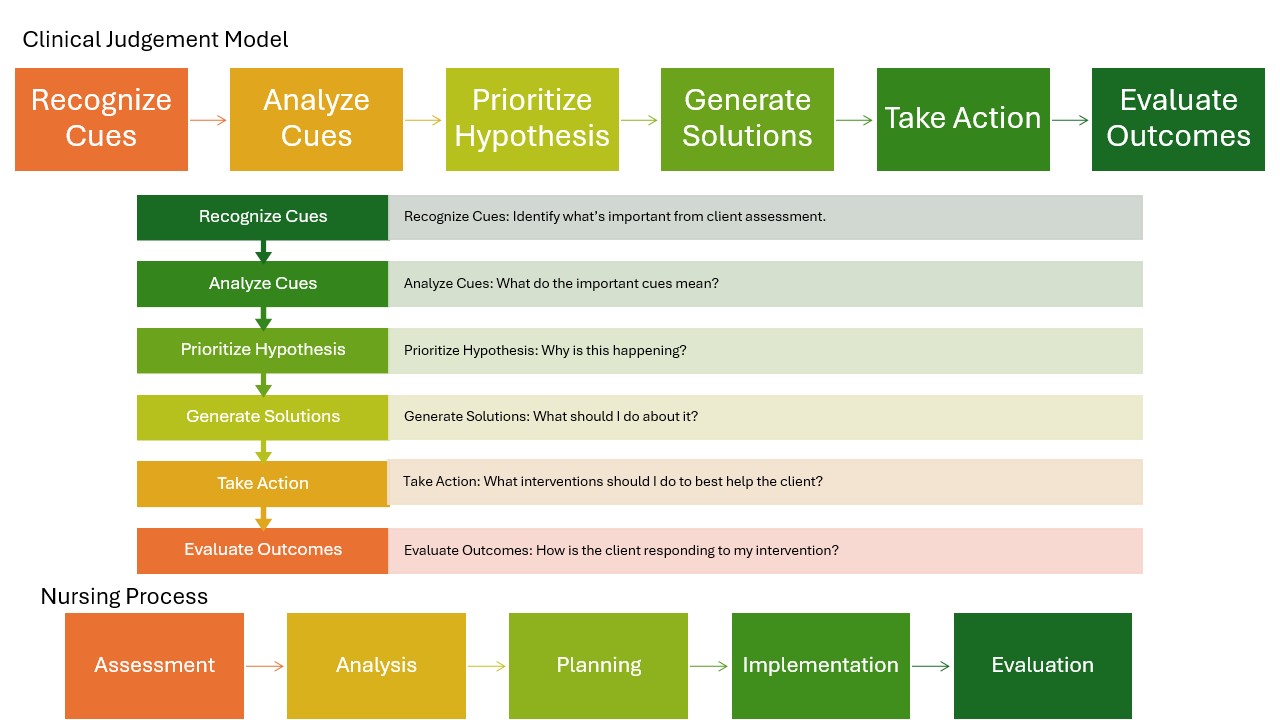
The clinical judgment model ensures that the tester can be a safe practicing nurse and is incorporated throughout the NCLEX® exam. The model also is being used in residency programs, preceptorships, and for new graduate orientation. Previously, the NCLEX® utilized the nursing process within the eight client need categories (Management of Care, Safety and Infection Control, Health Promotion and Maintenance, Psychosocial Integrity, Basic Care and Comfort, Pharmacological and Parenteral Therapies, Reduction of Risk Potential, and Physiological Adaptation). With the addition of the clinical judgment model, we have created this image to help you visualize the way it connects with the nursing process and what each means:Clinical judgment begins with recognizing cues, then analyzing those cues, prioritizing hypotheses based on those cues, generating solutions to those hypotheses, taking action while prioritizing the most important client needs first, and, finally, evaluating the outcomes of those actions.
Exploring the Next-Gen NCLEX® Question Item Types
But don’t forget about the new question item types that were added to the exam. The NGN NCLEX® will include three unfolding case studies in every exam. The tester will have to answer a series of questions via different item types. The case study will “unfold” and questions will apply to each of the new areas. There will also be bowtie questions; new multiple response item types that include Select All That Apply (SATA), select N, and multiple response group; and highlight questions that include highlight test and highlight table. Drag-and-drop questions that have the tester complete a sentence have also been added. Some questions will require you to complete one to three sentences, and others will be a rationale sentence that will be a cause-and-effect statement. Like drag and drop, there will also be drop-down questions where the tester will complete the sentence selecting from the drop-down options. Finally, there are now matrix grid questions where users will select answers in a matrix set. For more information on the new item types, reference our previous blog, “Include these Item Types in Your NCLEX® Practice Questions.”The NCSBN NCLEX® also updated the scoring for all item types. This ensures partial credit for multiple-part questions, including SATA. There are now four types of scoring models used in the NCSBN NCLEX®-RN. Partial credit scoring is used for items with more than one key. There will be three methods for scoring items for partial credit: plus/minus, zero/one, and rationale scoring.
Traditional Scoring
The “original” NCLEX® scoring type.
This scoring type means you either get the question right or wrong, there is no partial credit.
0/1 Scoring
Partial Credit Scoring Type.
With 0-1 scoring, the tester earns one point for each correct response picked and they earn zero points for each incorrect response picked. The total score for a multi-point item is the sum of all correct responses.
+/- Scoring
Partial Credit Scoring.
The tester earns one point for each correct response picked and also will subtract one point for each incorrect response picked. The total score for a multi-point item is the sum of all positive and negative points. *Negative total scores are a 0, there are no negative scores.
Rationale Scoring
The tester earns points when both responses in the pair are correct. This is applied to items that require a full understanding of paired information (e.g., cause/effect relationships).
The maximum number of questions for the Next-Gen NCLEX® also increased. The new NCLEX® has 85-150 scored questions (including 15 unscored pretest questions). It was previously 75-145 on the old version.
What Hasn’t Changed on the Next-Gen NCLEX®
The NCLEX® continues to be administered using computer-adaptive testing. This means the computer re-estimates the candidate's ability after each item is answered, based on the difficulty of the item and the candidate's previous answers. The computer then selects the next item for the candidate that is most optimal based on their previous responses. This ensures that the next item is neither too easy nor too hard, and the examination can obtain maximum information about the candidate's ability from the item. Candidates should find each item challenging because the items are targeted to their ability level. After each item is answered, the computer's estimate of the candidate's ability becomes more precise.The test also continues to be a pass/fail exam and remains timed with a five-hour limit. The exam will automatically shut off if the tester reaches the maximum time and/or maximum number of questions. The exam will then be scored, and a pass/fail result is given to the user.
The Bottom Line
Regardless of what has changed or what has remained the same, the NCLEX® still tests your abilities to be a safe practicing entry-level nurse. Preparation is key to passing the exam. Make sure you select a preparation like Slone NCLEX that will provide you with the structure, organization, and variety that mirrors the Next-Gen NCLEX®. Setting yourself up for success is what will make you the most confident on test day. Focus hard and prepare and you will do great!
You’ll need to focus on specialties when reviewing nursing NCLEX® questions, including categories like medical surgical nursing and mental health nursing.
Plan to include all eight National Council of State Boards of Nursing client need categories and the six NCLEX® clinical judgment categories when studying.
Be sure to review at least 200 to 400 questions per day until exam day.
When preparing to take the NCLEX® Exam, creating a well-rounded and comprehensive preparation program will help you be successful and pass the exam on your first attempt. Your plan will need to include all eight National Council of State Boards of Nursing (NCSBN) Client Need Categories:
Management of Care, which tests your ability to prioritize, delegate, and coordinate care for yourself, your patients, and other healthcare professionals.
Safety and Infection Control, which tests your ability to follow proper isolation precautions, sterile techniques, and general infection control protocols, such as proper hand hygiene.
Health Promotion and Maintenance, which tests your ability to properly educate patients on their preventative care and healthy lifestyle choices.
Psychosocial Integrity, which assesses your ability to assess and address a client’s emotional and psychological needs.
Basic Care & Comfort, which tests your ability to provide care to your patients in a safe way that promotes their care and ensures their basic needs are met and their ADLs are performed to the best of their ability safely.
Pharmacological and Parenteral Therapies, which test your understanding of medications, their administration, dosages, and side effects.
Reduction of Risk Potential, which tests your ability to identify and manage potential risks for patients such as medication errors, fall prevention techniques, and safe sex practices; and
Physiological Adaptation, which tests your ability to understand how the body responds to alterations in their health and the interventions needed to prevent further harm from occurring.
You'll also need to know the six NCLEX® Clinical Judgment Categories:
Recognize Cues
Analyze Cues
Prioritize Hypotheses
Generate Solutions
Take Actions, and
Evaluate Outcomes.
In addition to the NCSBN categories, you’ll need to focus on specialties when reviewing nursing NCLEX® questions. You will need to be able to answer questions in medical surgical nursing, pediatric nursing, maternal newborn or obstetrics nursing, pharmacology nursing, leadership, prioritization, delegation, and behavioral and mental health nursing.
Preparing for Nursing NCLEX® Questions
During your NCLEX® preparation, use questions like the ones on Slone NCLEX that provide a review that encompasses both the client need categories and clinical judgment. The NCLEX® is essentially the biggest nursing school final. It puts everything you have learned over the past few years into one exam. This is why being prepared and using a structured preparation program is so important. It is a lot of information for you to recall and recall accurately. So, when asked what NCLEX® questions you need to focus on, the answer is everything. The NCLEX® is administered via computer using computer adaptive testing. This means that if you answer a question correctly, the next question might be more difficult, and vice versa, which adjusts the difficulty level of the questions based on your performance. As you answer questions, the test calculates your competency relative to the minimum passing competency level. Once the exam determines your competency level, the test will end.Some tricks to help you remember those nursing NCLEX® questions include:
Pay attention to key words
Use the key words within the question stem to identify what the question is asking for.
For example, if the question is about education, it may be asking you which option indicates a need for further education or follow-up. The key word here is “further.”
Apply Maslow's Hierarchy of Needs
As a reminder, Maslow’s Hierarchy of Needs is in this order: Physiological (food, water, shelter, and rest); safety (security, stability, and freedom from fear); social and belonging (friendship, intimacy, and acceptance); esteem (respect, recognition, and status; and self-actualization (achieving one's full potential and creativity).
When answering questions, prioritize them based on addressing the highest-level of needs first.
Analyze rationales
Use your selected answer to see if it makes sense with the question. This is a great help you understand why the right answer is right and why the wrong options are wrong.
Remember safety is always the priority!
Key Factors in Nursing NCLEX® Questions
The most important thing for you to focus on when preparing to take the NCLEX® is to remember the key factors for every question:
The NCLEX® tests your ability to be a SAFE nurse who can provide entry-level nursing care and not harm anyone.
Focus on questions that prioritize patient care based on the "ABCs" of airway, breathing, and circulation.
Take practice questions that test your ability to recognize critical patient changes that require immediate intervention.
These nursing NCLEX® questions expect that you understand basic concepts such as Maslow's Hierarchy of Needs. You will also be expected to apply your knowledge to complex clinical scenarios, particularly those related to management of care, safety and infection control, and physiological integrity. Pay close attention to key details in question stems, such as vital signs, lab results, and medications. These are usually indicators of what you need to look for when selecting your answers. Other important areas to focus on are priority questions that have you identify the most critical patient needs and select the most appropriate interventions. Practice questions that require you to delegate actions and tasks to varying levels of healthcare professionals. Practice clinical scenario questions that apply your nursing knowledge to realistic patient situations. Finally, make sure you take a lot of medication administration questions, as these tend to hit almost every area of nursing NCLEX® questions and can assess every level of the clinical judgment process.
The Bottom Line
Your plan for NCLEX® should be to take 200-400 questions per day, every day, until your scheduled testing day. Also, do NOT wait to take the NCLEX® exam. You are never more ready to take the NCLEX® than when you have just completed nursing school. Nursing school exams are designed to align with the NCLEX® and force you to critically think so being in the mindset of answering nursing school style questions helps you to be successful!
It’s easy to caught up in how to approach NCLEX® test prep, but we want to remind you of what not to do as well.
Don’t let distractions get in the way of your study time, and don’t wait until the last minute to prepare.
Not using an NCLEX® test prep program like Slone NCLEX is also something to avoid.
We talk a lot about what to do to prepare for the NCLEX®, but with every positive there is a negative. The same can be said about NCLEX® preparation — There are tactics you should avoid in your NCLEX® test prep.
NCLEX® Test Prep Pitfalls
Here is a list of all the things you should remember (not to do!) heading into exam day:
Doing nothing will not help you!
There’s a rumor that if you passed nursing school, you don’t need to do anything to prep for the NCLEX®. This is a lie. Sure, there are people who have been able to take the exam without preparing, but they aren’t always successful. It is not worth the risk. Make an NCLEX® test prep study plan and stick to it.
Slacking off = lackluster results.
Once you’ve graduated from nursing school, it's so easy to feel like you are done and can take a break. But that’s a TRAP you must avoid. After nursing school is when you should be working overtime. You have one focus and that is to pass the NCLEX®.
Not using a prep program is a recipe for disaster.
There is a LOT of talk about not needing to use an NCLEX® Test Prep program. People are often falsely confident, then take the exam and don’t pass. Set yourself up for success and use a program like Slone NCLEX® that can provide a structured, detailed, and focused NCLEX® review.
Being distracted = being unprepared.
Oof, this is a tough one. Once you’re done with nursing school, you so badly want to just take a break. But you must be disciplined and maintain focus on taking and passing the NCLEX®. You need distraction-free time to focus. So keep those library dates. Continue to utilize day care. Whatever ways you created distraction-free study time in nursing school should continue until AFTER you have taken and passed the NCLEX®.
Don't cram! Don’t wait until the last minute
This one is so important. Last-minute studying leads to information overload and poor retention. You should begin your NCLEX® Test Prep during your final semester of nursing school and prepare every day until you sit for the exam.
Take 200-400 questions per day. Make sure those questions cover a variety of topics and are presented in a variety of ways.
Don’t rush.
Rushing through practice questions leads to rushing through the actual exam, which leads to careless mistakes. Take the time to read the questions thoroughly and give yourself time to really understand the rationales and why something is right and why something is wrong. Don't assume you know the answer without thoroughly reading the question and ALL of the answer options.
Don’t pinpoint your focus and lose the big picture. Diversity is key
The NCLEX® includes a variety of item types. Remember, in 2023 the NCLEX® underwent a major update and added a variety of new item types in addition to the traditional item types. Finding a test prep program, like Slone NCLEX, that offers a solid variety of item types and topics will set you up for success on test day.
NCLEX® is administered through computer-adaptive testing, meaning it will give you more questions on areas you’re weaker in, so present a well-rounded and comprehensive approach.
Don’t become lost in the specialties or facility-specific practices
Prioritize your studying by focusing on entry-level nursing knowledge that aligns with the NCLEX® blueprint.
Remember the NCLEX® tests you over perfect-world nursing with all resources available. So don’t answer questions based off what you see at your facilities. Keep your answers to the exam’s standard.
Neglecting your self = neglecting your success.
This is easier said than done. You need to make sure you are eating, but more importantly, that the food you are eating is healthy, feeds your brain, and helps you focus. Foods such as berries, nuts, leafy greens, eggs, dark chocolate (yes, chocolate), avocados, and even coffee (before noon) are proven to help boost brain activity and improve focus. Additionally, you have to sleep! I know that can be a challenge, but it is evidenced-based in study after study that your brain needs rest, and you need to sleep! So, make sure that when you are creating a study plan, sleeping and a balanced diet are part of it.
Ignore your weaknesses = ignoring opportunities.
There is no bigger lie than the one you tell yourself. You know you are weak in some areas of nursing and that there were areas in nursing school you really struggled through. Make sure you give yourself extra time to review those areas.
Taking a readiness exam like the one we have on Slone NCLEX will help you identify your knowledge gaps and provide a focused and targeted review to help you improve those areas.
The Bottom Line
Avoiding these things in your NCLEX® test prep will help you pass the exam with flying colors. Only you can take your NCLEX® exam, so give it the attention it deserves. You have worked too long and too hard getting to this point to not give it your all and avoid these basic sink holes. You can do this. You just need to set yourself up for success and not failure.